The benefits platform revolution: Why 46% of employers have already made the leap
09.12.25
HR and Reward leaders are done with the spreadsheets. The shift to connected benefits tech is gathering serious pace – and for good reason. As global workforces grow more complex, the old patchwork of systems, portals, and providers simply can’t keep up. AI and integrated platforms are stepping in to simplify the chaos and put control back in People teams’ hands.
The pressure is on: Fragmented systems can’t keep up
More employers are realizing they can’t keep up with spreadsheets, endless admin, and disconnected systems – the outcomes are poor, and the risks are high.
Many organizations have invested extensively in HR tech – for example deploying a global HRIS such as Workday, SAP or HiBob. They may also have invested in platforms like ServiceNow, Agentforce or Copilot to improve how support is delivered.
And the adoption of benefits platforms has rocketed in the past 12 months too. This is unsurprising given benefits providers typically share a wealth of content and information across multiple channels – from policy documents to their own portals. For employees, this can quickly become overwhelming; for employers, it’s hard to feel in control without a tech solution in place.
The rise of global benefits platforms
Today, 32% of employers use a single, unified platform, and another 14% manage multiple platforms across regions. That’s a huge jump from just 12 months ago, when those numbers were in single digits.
Clearly, many of the 78% of employers who were considering investing in a platform last year have taken the plunge – and with 51% still planning to implement one, the momentum is only going one way.
This graphic highlights the accelerated adoption of benefits platforms:
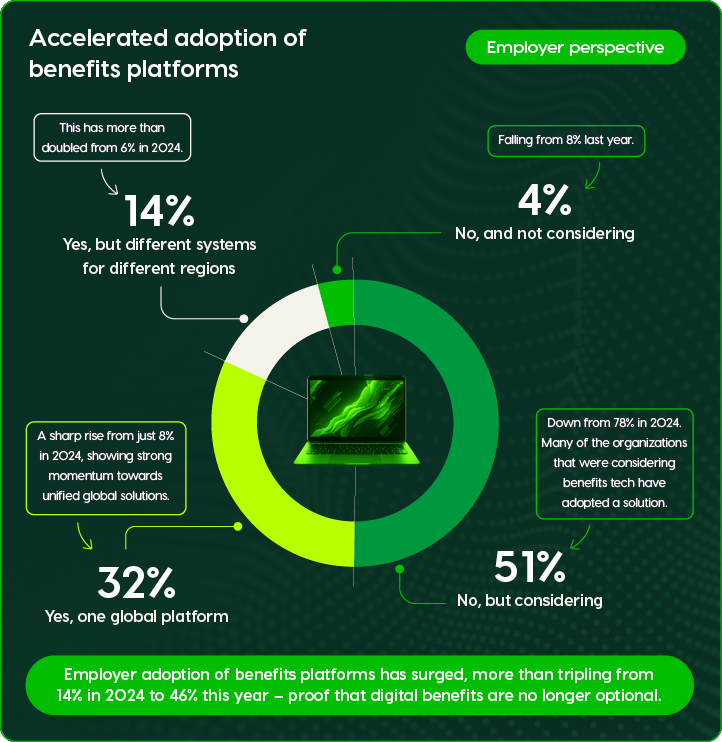
Employer adoption of benefits platforms has surged, more than tripling from 14% in 2024 to 46% this year – proof that digital benefits are no longer optional.
So what’s driving this trend? At its heart, it’s about making life easier for employees. A platform brings everything together in one place – so people can actually understand their benefits, make smarter choices, and see the value of what’s on offer.
Of course, global benefits platforms also deliver big wins for People teams: less admin, time savings, easier compliance, and clearer insights into benefits adoption, engagement, and costs.
Integration, not isolation: How AI connects the dots
And AI is no longer just about what individual platforms can do – it’s about how they connect. The real opportunity lies in creating experiences that meet people in the flow of work, rather than forcing them to jump between disconnected systems.
Instead of platforms being judged purely on their own functionality, a key measure of success is how well they integrate. AI is accelerating this shift: stitching together specialist systems, orchestrating data, and guiding employees seamlessly between environments. We’re beginning to see a new generation of connectors emerge – fusing HR platforms into a coherent, intuitive experience.
Given the wealth of data and content that a global benefits platform holds, it is a central part of this ecosystem. Tools such as Copilot are already showing how integration – not replication – can unlock more value by consolidating information across systems. For employees, this means that a single question spanning multiple areas (from booking leave to benefits entitlement) can be connected into a single experience. The focus shifts from managing systems to putting the experience first.
71% of HR and Reward professionals say that without the right technology, they feel powerless to progress their organization’s benefits strategy.
59% of HR and Reward professionals in global companies say a single, scalable platform for rewards, benefits, recognition and wellbeing is key to overcoming complexity
51% emphasize the importance of integrating HR systems with a benefits platform
The results speak for themselves
Crucially, AI is now supercharging benefits platforms. Content can be created at speed and in multiple languages, campaigns can be rolled out at scale – while People teams keep control over brand messaging, tone, and timing.
The results speak for themselves: employers are tracking spend more accurately, boosting engagement, and seeing tangible improvements in talent attraction and retention.
Employees get a smoother, more intuitive experience – which means they understand their benefits better and use the ones that make the biggest difference to their everyday lives.
As benefits become a strategic lever for employers to attract and retain a world-class workforce, benefits platforms are mission critical. A “benefits admin” system is not enough – companies need greater value from their investment in benefits.
Global benefits platforms need to act as a system of control, engagement, and insight. A modern, intelligent benefits platform should turn complexity into simplicity, turn fragmented data into actionable insights, and automate workflows. And AI’s ability to analyze vast datasets, personalize employee experiences, and automate tasks at scale makes the case for benefits technology even more compelling.
Don’t just digitize – connect
The numbers tell the story: benefits platforms are no longer optional – they’re essential. With 46% of employers already using one and another 51% planning implementation, the shift from fragmented to connected is happening fast.
The organizations moving first are already seeing the advantage: stronger employee engagement, clearer compliance visibility, and the solid foundation needed to layer AI across their entire rewards ecosystem. Those that wait risk falling behind in a landscape that’s moving faster every quarter.
Employees now expect seamless, intelligent experiences. Business need control, insight and ROI. A unified, AI powered benefits platform delivers both. The real question isn’t whether you’ll make the move – it’s how soon you’ll make it.
Download Benifex’s report, ‘How People teams are using AI to cover more ground and deliver better benefits experiences’ to explore how AI is transforming HR and Reward, and what’s coming next for People teams.