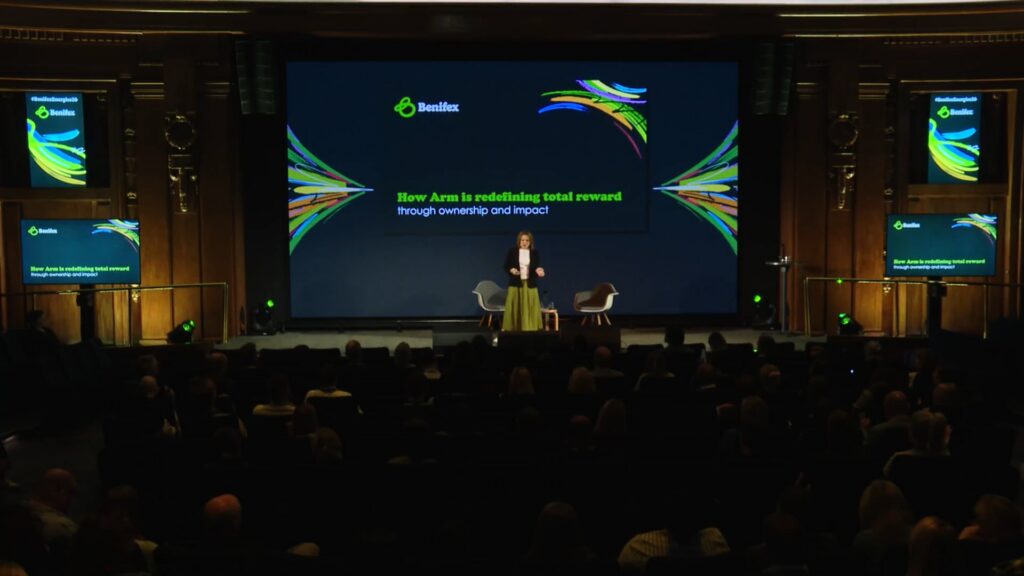
How Arm is redefining total reward through ownership, visibility and purpose
21.07.26
What does total reward really mean in practice? And how do you bring it to life in a way that employees genuinely understand – and value?
That was the central question at the heart of one of the standout sessions at Benifex Energise, our flagship customer event. In a fireside conversation on stage, Ryan Hollas, Director of People Technology at Arm, joined Adam Mason, Chief Strategy Officer at Benifex, to share the story of how Arm has fundamentally transformed its approach to total reward – moving from a complex, cash-heavy model to something more holistic, transparent and deeply connected to the company’s growth.
The result is a reward strategy that doesn’t just pay people well. It makes them feel like owners.
The communication problem at the heart of reward
Adam opened the session with a provocation: most organizations don’t have a reward problem. They have a communication problem. Ryan agreed – and added important nuance.
“Everyone has best intentions with demonstrating the reward we want to give our people and how we want to recognize our people and give back to them as individuals. But I think what we inherently do when we communicate is we either over-index or under-index. So people can’t see the wood for the trees and actually understand what it means for them.”
— Ryan Hollas, Director of People Technology, Arm
Before 2023, Arm had a generous but fragmented reward structure. Eight different cash-based elements sat behind multiple layers of systems and clicks. Employees would notice unexpected amounts in their bank accounts and call payroll to check nothing had gone wrong. Personalized vesting schedules existed, but finding them meant 15 minutes of navigation through clunky, Excel-based tooling. Engagement was low – not because people didn’t care, but because the experience made it too hard to care.
“People just weren’t really engaging with it. We had mechanisms in place, but it always felt like it was layered behind tech or multiple click throughs in an application.”
— Ryan Hollas, Director of People Technology, Arm
The shift: from cash to ownership
Arm’s IPO in 2023 was the catalyst for change. The organization took the opportunity to fundamentally rethink its reward offering, with stock becoming the central pillar. Cash elements were removed. Quarterly vesting cycles and a four-year stock allocation were introduced – creating something that felt more organic, more trackable, and more tied to the company’s long-term success.
But the mechanics alone weren’t the point. The bigger shift was cultural: making employees feel like genuine stakeholders in Arm’s future.
“Our engineers create intellectual property for Arm to be successful. So it made absolute sense that stock became that main reward catalyst for us. But, again, it’s how do we make it simple? How do we make it engaging and not hidden behind layers?”
— Ryan Hollas, Director of People Technology, Arm
Working with Benifex, Arm built a total reward statement (TRS) that gave every employee full, self-serve visibility of their stock allocation – including a four-year vesting forecast, live modeling capabilities, and a daily-updated share price feed. The result was an experience that made ownership feel real, not abstract.
When employees watch the stock price in real time
Ryan shared a moment that captured the shift better than any engagement metric could. When Arm’s CEO made a major live announcement about the company’s move into silicon manufacturing, Ryan walked through the office and saw something telling.
“The amount of people that had their iPhones out with the stock app open watching the stock price go up was telling. People now see the direct delineation between the input and the outputs of their work through to the stock price and Arm being a successful company and what it means to them through our TRS.”
— Ryan Hollas, Director of People Technology, Arm
The underlying point was clear: employees weren’t just beneficiaries of Arm’s success. They were invested in it, watching it in real time, because they had the tools to understand what it meant for them personally.
This kind of engagement didn’t happen by accident. It came from years of deliberate work to make reward visible, tangible and meaningful – and from building a culture of transparency where quarterly business updates, open Q&As with leadership, and honest conversations about the company’s direction are the norm.
Beyond stock: making the full picture visible
Stock may be the headline, but Arm’s total reward story is broader than equity. The TRS now surfaces the full picture – sabbaticals earned every four years, six volunteering days a year, additional leave entitlements and benefits – sitting alongside the stock component in a single, unified view.
“The weight that stock carries, it’s a great opportunity to signpost other things that are important to Arm and our people. Things like highlighting that we have a sabbatical, highlighting that six days a year you can go away and do volunteering for organizations that you’re passionate about. All of that is visible under our total reward statement to remind and indicate to people that there are other things outside of stock.”
— Ryan Hollas, Director of People Technology, Arm
The modeling capability is central to this. Employees can use the platform to explore different scenarios – what their stock looks like if they hold for longer, what workplace pension contributions add up to over time, how the full value of their package compares to what they might find elsewhere. It’s self-directed, personalized and empowering.
A cultural shift – not just a technology one
One of the most powerful themes in Ryan’s account was the impact on culture. When employees understand their reward, when they can model their future, when they feel connected to the company’s performance – something shifts in how they show up.
“I personally feel there has been a huge shift in regards to how people show up culturally. There’s a huge drive towards AI and making the business more efficient. If we make things more efficient for our people, driving the efficiencies, enabling people to do better work makes the organization better, pushes up the share price. So that sense of ownership and wanting to be better has really helped us move the dial, making Arm more efficient, deliver better product and support our partners.”
— Ryan Hollas, Director of People Technology, Arm
This sense of ownership has been particularly significant for Arm’s long-tenured employees – colleagues who have been with the company since its early days and who have watched it grow into a global technology leader. The total reward statement gives them a way to connect that personal journey with their financial future, reinforcing both loyalty and purpose.
The business case: walking the leadership team through the experience
Ryan was candid about how he built the internal business case – and it was refreshingly simple. He sat down with Arm’s People leadership team and walked them through the current employee experience. No polished deck. Just the reality.
“I had a meeting with our People leadership team, and I walked them through the current experience at that time. I said, ‘Is this what we want?’ When you take the opportunity to walk through the experience that you expect your people to go through and you feel underwhelmed – that writes itself.”
— Ryan Hollas, Director of People Technology, Arm
The leadership team was surprised. What had seemed like a functional system looked disjointed and underwhelming when experienced as an employee would. That moment of clarity – of seeing the gap between intention and reality – was the business case.
It’s a lesson worth sitting with: sometimes the most powerful argument for change isn’t a spreadsheet. It’s showing people what it actually feels like.
The future: AI, data and proactive experiences
Looking ahead, Ryan is excited about the role AI can play in making reward genuinely proactive – not just available, but anticipatory.
“I feel we have the mechanisms in place to enable a really holistic and great experience leveraging AI capability for our people. I want to see a space whereby we can leverage AI capability to meet people in the moments that matter. I want it to be proactive, not reactive.”
— Ryan Hollas, Director of People Technology, Arm
He described a future where AI agents check whether someone has taken their holiday, surface relevant guidance when an employee is researching parental leave or sabbatical policy, and provide personalized answers rather than generic content. The foundation for this, Ryan was clear, is data – consolidated, accurate and centrally held.
“Our partnership with Benifex, essentially being able to consolidate all of those key data points around someone’s salary, stock, their benefits – having that data consolidated into one platform where it can enable an AI experience centrally that will always be consistent and accurate as opposed to having a disjointed or cumbersome approach – is really important to us.”
— Ryan Hollas, Director of People Technology, Arm
One piece of advice: leave the posters behind
Adam closed the session by asking Ryan what one piece of advice he’d give to anyone at the start of this journey. The answer was direct – and useful for any organization thinking about reward communication.
“Don’t rely on posters. Get a clear understanding on how you can articulate what is important to you and the organization. It needs to be meaningful. Too much noise – I disengage. But actually, if you’re able to fly three, four key things that are important to the organization’s culture – that’s a really important lesson to take away. If your company cannot articulate what it wants to be important, then how can you ever enable technology to drive that journey?”
— Ryan Hollas, Director of People Technology, Arm
It’s a challenge as much as it is advice. Before thinking about platforms, modelers or AI – get clear on what you actually want your people to understand and feel. Technology can amplify a message, but it can’t create one.
Key takeaways from the session
- Reward communication is often the problem, not reward investment. Employees can’t value what they can’t see or understand.
- Visibility creates engagement. When employees can model their stock, their pension and their total package in one place, they start thinking like owners.
- The business case can be simple. Walking leadership through the employee experience – and letting them feel the gap – is often more powerful than any proposal document.
- Non-financial reward needs to be visible too. Sabbaticals, volunteering days and other benefits only land if they’re surfaced alongside the financial picture.
- Focus before you amplify. Get clear on the three or four things that matter most to your organization before asking technology to tell that story.
- The future is proactive. AI has the potential to meet employees in the moments that matter – but only if the underlying data is consolidated and accurate.
Watch the full session on demand to catch Ryan and Adam’s conversation in full.