
How employees can get more value from their salary — without earning more
02.07.26
Most employees in Denmark have never heard of gross benefits. But once they do, the question is usually the same: why didn’t anyone tell me about this sooner?
Gross benefits, known in Danish as bruttolønsordningen, is an arrangement that lets employees unlock more value from the salary they already earn, simply by changing how part of it is structured. For HR teams, that’s a compelling proposition: a more attractive benefits offering, with no additional cost to the business.
How it works
The idea is straightforward. Instead of receiving a full salary in cash — and then buying things with money that’s already been taxed — employees can agree with their employer to have certain benefits paid directly from their gross salary, before tax is calculated.
Because the deduction happens before tax, employees pay tax on a lower amount. In practice, this means they get more value out of every krone they earn.
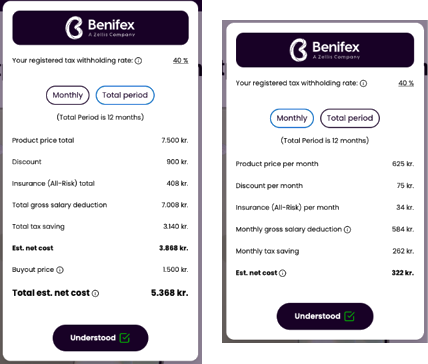
Here’s a real-world example of what gross benefits can look like in practice. Say an employee wants a new phone through their employer. The product costs 7,500 DKK in total, 625 DKK per month for a full year. After a discount of 75 DKK per month (900 DKK in total) and All-Risk insurance of 34 DKK per month (408 DKK in total), the monthly gross salary deduction comes out at 584 DKK (7,008 DKK in total). Based on a tax withholding rate of 40%, the monthly tax saving is 262 DKK (3,140 DKK in total) — bringing the estimated net cost to the employee down to just 322 DKK per month (3,868 DKK over 12 months).
What can be included?
A range of common benefits can be part of a gross benefits scheme:
- Mobile phone and broadband
- Public transport pass
- Massage and wellness
- Training and professional development
- Newspapers and professional literature
Not all benefits offer the same tax advantage, so it’s always worth checking the specific implications for each benefit before setting up the arrangement.
What it means in practice
Employees formally take a reduction in gross salary, but in reality, they get more. That’s what makes the arrangement attractive.
There are, however, a few important things to be aware of:
Minimum commitment period. A gross benefits scheme typically runs for at least 12 months. Employees cannot change their minds halfway through the agreement period.
Impact on pension and holiday pay. Because the gross salary is reduced, it may in some cases affect pension contributions and holiday entitlement. Employees should always check how this applies to their specific situation before signing up.
The employer owns the benefit. It’s the employer who provides the benefit, not the employee who purchases it and is then reimbursed.
Why employees don’t always know about it
The most common reason employees miss out on gross benefits is simply a lack of awareness. The arrangement isn’t complicated — but it does require the employer to communicate it clearly, make it easy to sign up for, and help employees understand what they stand to gain.
This is where a modern benefits platform makes a real difference. When gross benefits are integrated into a platform where employees can easily see their options, understand the value, and make their choices in a few clicks, take-up rates increase significantly. Without that visibility, even the best offering risks going unused.
A related scheme worth knowing about: fritvalgsordningen
For employees covered by certain collective agreements in Denmark, particularly in the public sector and parts of the private sector, there’s a related arrangement called fritvalgsordningen. Under this scheme, a portion of the salary (typically around 6–8%) is set aside in a flexible “free choice” account that the employee can allocate as they wish.
Common options include extra pension contributions, additional holiday, or a cash payout. But fritvalgsordningen can also be used to fund benefits through a gross benefits scheme — combining the flexibility of the free choice account with the tax advantages of bruttolønsordningen.
Not all employees have access to fritvalgsordningen, as it depends on the collective agreement that applies to their role. But for those who do, it adds another layer of flexibility to how they can structure their total compensation.
What HR can do
For HR and reward teams, gross benefits represent a straightforward opportunity to increase the perceived value of the total rewards package — at no extra cost to the organization. The key is making sure employees actually know it exists, understand how it works, and have an easy way to take advantage of it.
That means proactive communication, clear guidance on what’s available, and ideally, a benefits platform that brings everything together in one place.
Gross benefits won’t make headlines. But for employees who understand and use the scheme, the impact on their monthly finances can be surprisingly significant. And for employers, it’s one of the simplest ways to strengthen the benefits offering without increasing costs.
If you’d like to find out more about how your organization can get started with gross benefits, get in touch with us here.