Why global employers are going digital with benefits – and what’s next
13.11.25
After years of slow shifts and manual workarounds, digitizing benefits is now a priority – not a future ambition. In the past 12 months, adoption of global benefits platforms has more than tripled. And the gap between employee expectations and employer capabilities is the driving force behind it.
Let’s explore what’s fueling the shift to digital, why AI is raising the bar, and how leading organizations are using benefits tech to simplify, scale and succeed.
Why global benefits tech is on the rise
The expectation gap between what employees want and what they receive continues to drive global benefits tech investment.
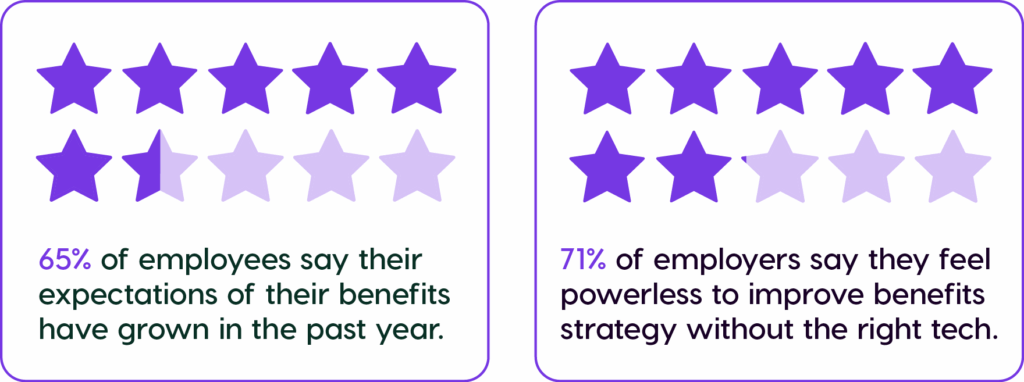
To close the gap, global employers are modernizing how they deliver, manage, and measure benefits. In the last year, there’s been a notable shift from planning to action. Many organizations that were previously in the exploration phase of benefits technology have now made the leap, moving from fragmented or manual processes to integrated global platforms.
This momentum signals a wider transformation: where tech was once a future goal, it’s now becoming the foundation for reward strategies at scale. Adoption is accelerating fast – many of the organizations that were previously planning to implement a global benefits platform have now done so, with 50% of international employers and 33% of UK-only employers already using one.
Global employers face growing pressure to deliver benefits that are both strategically aligned and locally relevant. From regulatory complexity to rising employee expectations, the case for digitizing benefits delivery has never been stronger.
Digital adoption is accelerating – fast:
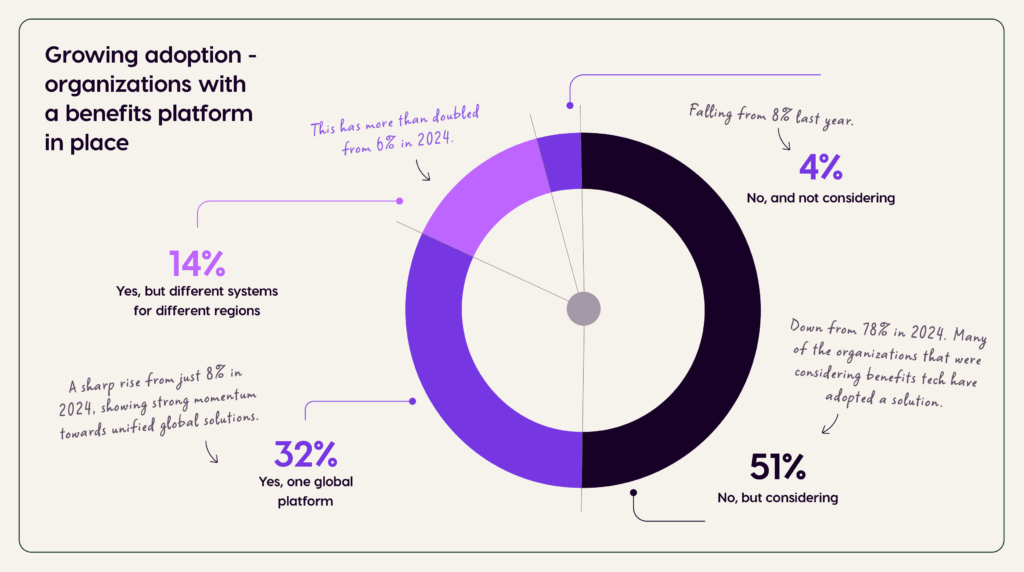
Employer adoption of benefits platforms has surged, more than tripling from 14% in 2024 to 46% this year – proof that digital benefits are no longer optional.
The drivers for global benefits technology
Organizations are implementing global benefits technology to streamline administration, reduce manual processes and improve employee experience through easier access and personalization. Reward and Benefits leaders also use it to enhance data visibility and reporting, improve governance and compliance, and drive cost-efficiency while avoiding over-insuring or underutilized spending.
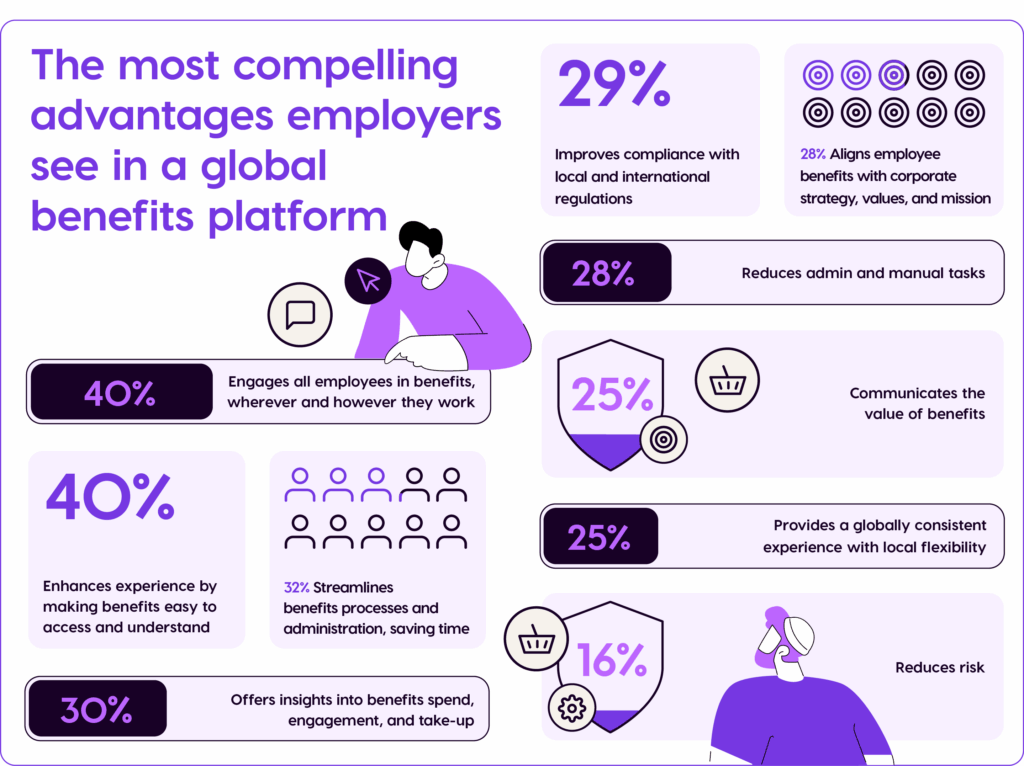
Recent shifts – like hybrid work, international expansion, and the need for a stronger EVP – have only intensified these drivers.
“We looked at the growth journey that we were on and determined that we wanted to improve our employee experience exponentially, and we needed a really good platform to do that on the benefits side of things. When I think back to our business case around investing in this area, it was very, very strong – on the hard, dollar side of things as well as on the soft experiential side. And I would say it’s paid back so far in spades – 100%, whether it’s through compliance and data security, whether it’s through the employee experience – it’s all returned to the business.” – David Nugent, Group Director of Performance & Reward, Alter Domus.
Takeaway: Managing global benefits in spreadsheets increases risk and limits impact. Digitizing your approach improves efficiency, protects your EVP, and helps avoid costly errors.
How AI is transforming the benefits experience
The rise of AI is redefining how organizations deliver, manage, and experience employee benefits – while benefits tech is becoming even more dynamic, responsive, and personalized.
Employee expectations are rising fast – and 96% of employers believe AI in HR and benefits will be key to meeting them in the moment. From answering questions in real time to surfacing relevant benefits based on life stage, AI acts as an intelligent layer that empowers employees and frees up HR teams to focus on strategy instead of administration.
“Employees don’t want endless options; they want clarity, confidence and support at their fingertips. That’s where AI excels – not as a replacement for human interaction, but as an intelligent layer that guides, empowers, and enables employees to take action.” – Ross Spearman, Chief Experience Officer, Benifex.
“This experience is designed to meet employees in the moment, with just the right amount of context to help them take action and make the right choices in moments that matter.” – Craig Foster, Director, HR Digital Transformation, Microsoft,
What does this look like in practice?
For employees: AI can explain eligibility rules, recommend benefits based on individual needs, and answer common questions instantly – without people having to raise a ticket or wait for HR.
For HR teams: AI unlocks smarter analytics, improves scheme design, and supports consistent global governance by making data actionable in real time.
AI is a strategic partner. Across our client base, we’re seeing this shift already in motion. Whether it’s decision support for employees or proactive prompts for HR based on usage patterns, AI is turning complex systems into intuitive experiences.
Takeaway: AI is no longer a future ambition – it’s a present-day advantage. By embedding intelligence into benefits platforms, forward-thinking employers are creating seamless, personalized experiences that boost engagement, support wellbeing, and unlock strategic value.
A smarter, faster future for global benefits
We’re seeing a clear shift: digitizing benefits is no longer a nice-to-have – it’s becoming the global standard. With 46% of international employers now using a benefits platform (up from 14% in 2024), and 51% planning implementation, momentum is building fast.
Why? Because modern expectations can’t be met with spreadsheets.
Organizations investing now are gaining a competitive edge in engagement, efficiency, and governance. Those waiting risk falling behind – or implementing under pressure when challenges arise.
Global benefits tech isn’t just keeping pace. It’s helping employers lead.
Want to see how leading employers are navigating global benefits in 2025? Download the full Global benefits in practice report for practical insights, real-world case studies, and expert commentary on what’s next in global benefits.
Paul Andrews
Global Benefits Director